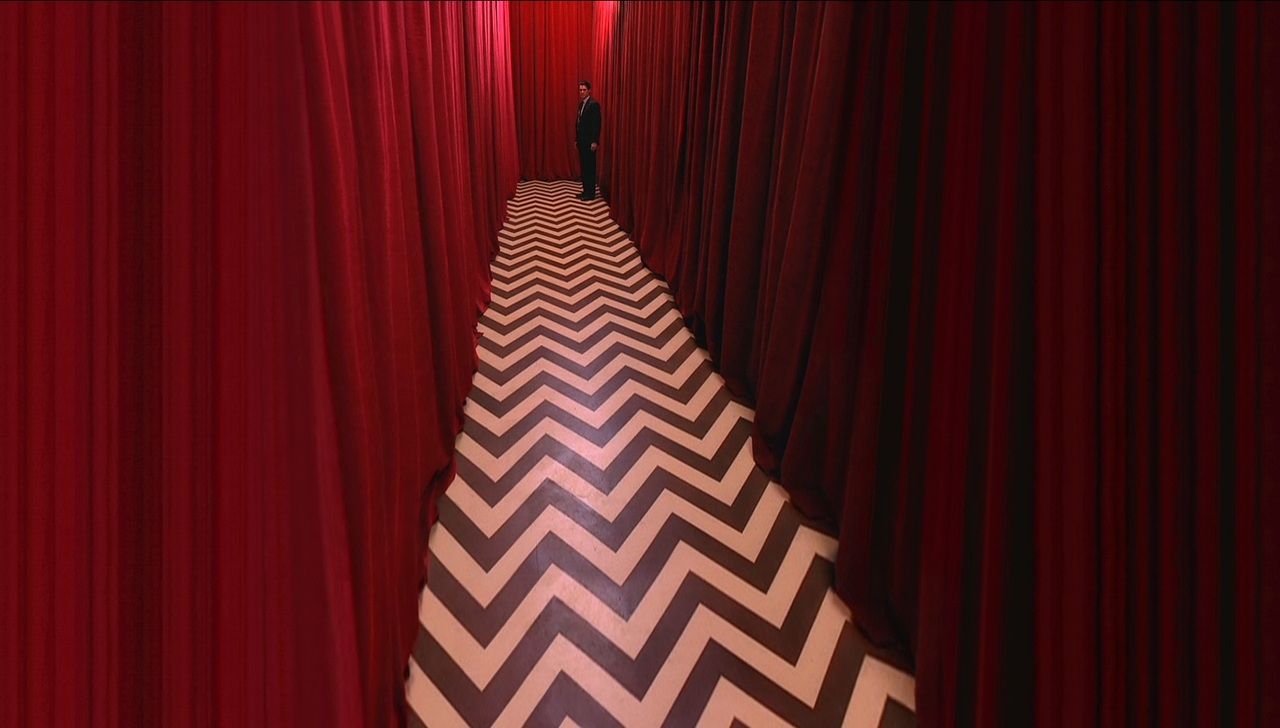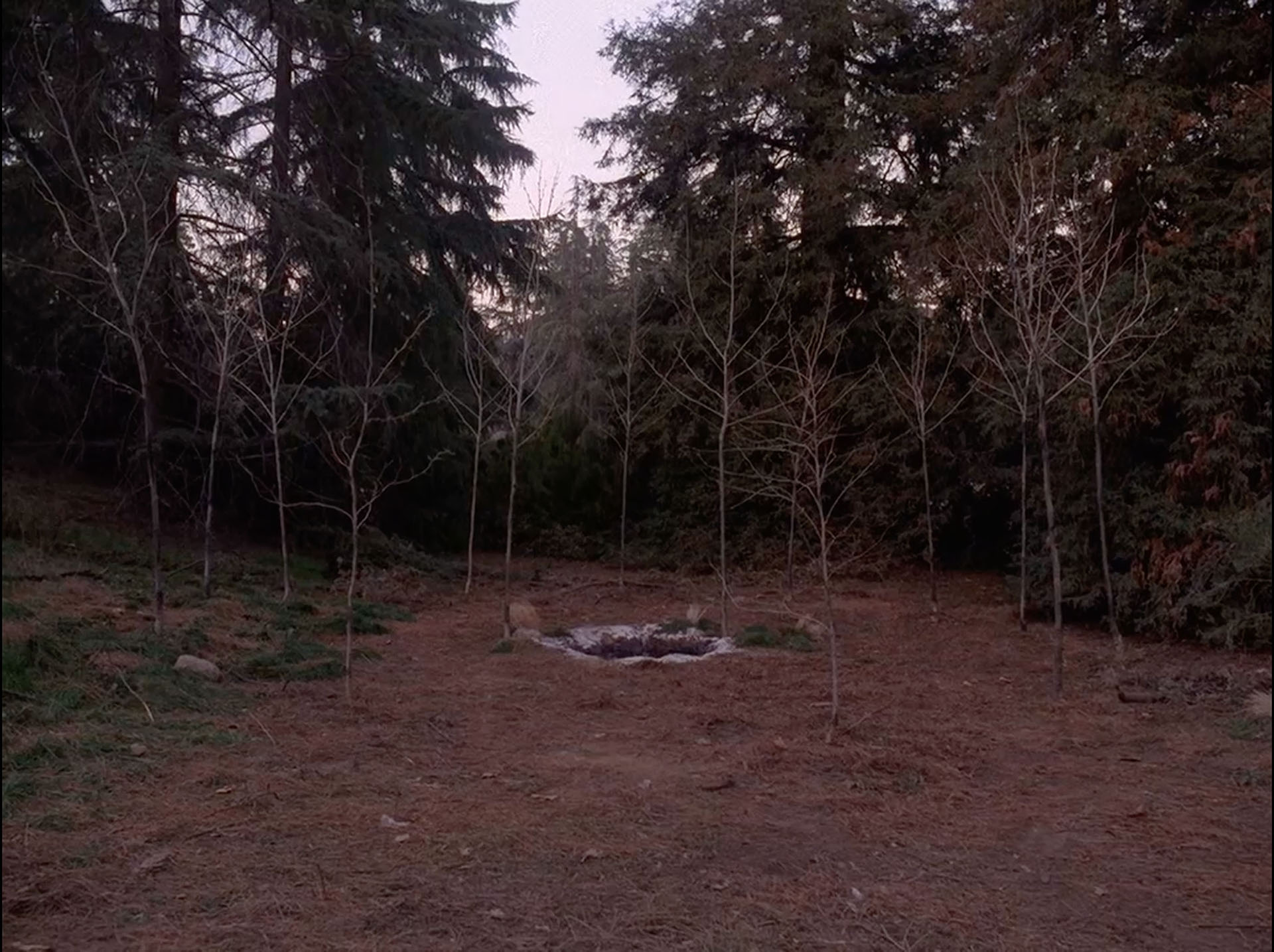
The most dangerous doorway in Twin Peaks does not look particularly interested in your safety. It is a circle of twelve sycamores, a pool of black oil, and a set of red curtains that appear where curtains have no business appearing. And yet this peculiar place has a very particular name: Glastonbury Grove. Unlike the real Glastonbury, there is no abundance of patchouli-scented gift shops.
Why Glastonbury? The real Glastonbury is in Somerset, England, thousands of miles from the fictional Washington town. It is associated with Avalon, King Arthur, the Grail and a remarkable accumulation of stories about places where one world touches another. That makes the name an extraordinarily suggestive choice. But suggestive is not the same as proven: Twin Peaks never gives a straightforward explanation of why its woodland portal was named after a small English town.
What Does Twin Peaks Tell Us About Glastonbury Grove?

In the original series’ finale, “Beyond Life and Death” (Season 2, Episode 22 in the broadcast-season count; commonly numbered Episode 29 overall), Deputy Hawk identifies the place shown by the Owl Cave markings: a circle of twelve sycamore trees called Glastonbury Grove. Windom Earle brings Annie Blackburn to the grove. Cooper follows, sees an owl, and enters after red curtains appear among the trees. Inside, ordinary geography gives way to the strange rooms and corridors associated with the Black Lodge.
The grove is a threshold, rather than an ordinary wooded clearing with unusual interior decoration. The series establishes a connection between its trees, the Owl Cave image, the oil pool and the entrance, but does not provide a complete instruction manual. Nor does it announce that everything beyond those curtains belongs only to the Black Lodge. That uncertainty is important when we start mapping the cosmology.
We have already examined the clearing as an entrance in What Actually Is the Black Lodge?. Here, the question is more specific: why give this Washington grove the name of a legendary English landscape?
What Is the Real Glastonbury?

Glastonbury is a real town in Somerset. Above the surrounding levels rises Glastonbury Tor, crowned by St Michael’s Tower. To a modern visitor it is a striking hill. To centuries of storytellers, it has been considerably more: a place whose geographical isolation, religious history and imagined antiquity invite myth.
The archaeological and documentary history of Glastonbury Abbey is more grounded than the legends. The abbey notes that its earliest firm historical evidence comes from late seventh-century charters, supported by archaeological evidence of an early church. This does not authenticate the much older foundation stories told later. A location can be steeped in real history and also acquire a grand mythology without every legend becoming a fact.
The National Trust describes the Tor as overlooking Glastonbury and the Isle of Avalon. The landscape itself does some of the storytelling: rising ground above the surrounding lowlands can look like an island, especially when mist settles in the fields. Once you have seen a hill emerging from fog, it is not difficult to imagine why someone might call it the edge of another world. The National Trust’s Tor guide is a useful place to start.
Why Is Glastonbury Associated With Avalon?
Avalon is the island of Arthurian legend, above all associated with King Arthur’s final journey after his mortal wounding. In medieval storytelling, the otherworld is not simply a place where the dead go. It can be a realm of healing, concealment and suspended endings: somewhere a king may be taken without his story being quite finished.
Glastonbury’s association with Arthur and Avalon became especially important in the Middle Ages. The monks of Glastonbury Abbey claimed to have discovered the remains of Arthur and Guinevere in 1191. The claim was historically influential, but it is not accepted as archaeological proof that the legendary Arthur was buried there. An abbey could benefit enormously from a famous burial site; people travelled to visit sacred places, and stories helped establish authority as well as enchantment.
Twin Peaks has its own missing people, interrupted destinies and uncertain returns. Cooper enters the grove and spends twenty-five years absent from ordinary life. Major Briggs disappears and returns altered. Laura is both irretrievably murdered and persistently present. These are thematic parallels with Avalon stories, not evidence that the creators intended a one-to-one Arthurian code. Still, a place associated with someone who is gone without being entirely gone is a pointed name for Cooper’s doorway.
Where Do Joseph of Arimathea and the Holy Grail Fit In?
Glastonbury also acquired Christian legends connecting it to Joseph of Arimathea, the figure associated in the Gospels with the burial of Jesus. Later traditions claimed he travelled to Britain, founded an early church at Glastonbury and became entangled with stories of the Holy Grail.
Glastonbury Abbey itself distinguishes these legends from demonstrable historical origins. As its guide to myths and legends explains, stories about Joseph, Arthur and the Grail developed over time, sometimes reinforcing the abbey’s claims to exceptional antiquity and prestige.
The important connection to Twin Peaks is not a secret Grail supposedly hidden beneath an American forest. It is how a real site becomes a meeting point for multiple traditions: Christian holy place, Arthurian landscape, imagined threshold and destination for seekers. Glastonbury Grove similarly accumulates meanings. It is simultaneously a set of trees, a mark on a map, an occult doorway and the location of an intensely personal ordeal.
Is Glastonbury Grove a ‘Thin Place’?
A thin place is a modern expression often used for a location where the barrier between the everyday and the sacred feels unusually slight. It is frequently associated with Celtic landscapes and spirituality. But it is worth being careful: presenting the phrase as a uniform ancient Celtic doctrine oversimplifies a diverse body of traditions. The language can describe a contemporary spiritual experience without proving that people in antiquity used exactly the same framework.
As a reading of Twin Peaks, though, the idea is compelling. Cooper does not board a plane to another dimension. The world opens in the woods. No enormous physical distance separates him from the red curtains; what changes is the status of the place itself.
The woods of Twin Peaks are full of boundaries that appear ordinary until they are not: Owl Cave, Jack Rabbit’s Palace, the convenience store and the Dutchman’s all complicate the idea that supernatural space must be far away. A thin-place interpretation draws attention to that permeability. It should not be confused with a canonical explanation or a verified pre-Christian Glastonbury ritual.
Why Are There Twelve Sycamores?
Twelve is a conspicuous number. It appears in many religious and mythological traditions, but the presence of twelve trees does not tell us which of those traditions, if any, the series is borrowing. Twelve apostles, twelve months and twelve zodiacal signs are all tempting comparisons. At least twelve Knights of the Round Table. None is demonstrated by the scene.
The sycamores themselves matter just as much as the number. They turn an area of forest into a recognisable circle. A ring can define an inside and outside, a protected precinct or a ceremonial space; in the episode it also frames the supernatural opening. Yet we should resist quietly rewriting the circle as an authentic ancient British grove, or as a Native American ceremonial structure. Those claims require evidence that the show does not provide.
The eventual Twelve Sycamores deep dive will examine sacred trees and ritual circles properly. For now, it is enough to observe what the camera gives us: trees arranged into a threshold, and a threshold that activates when the story reaches its most dangerous point.
Was Annie’s Abduction Inspired by Arthurian Legend?

The most striking parallel is not simply that Arthur was supposedly buried at Glastonbury. It is that Glastonbury was also the setting of a story about an abducted queen. In the twelfth-century Life of Gildas, attributed to the Welsh cleric Caradoc of Llancarfan, Melwas takes Guinevere to Glastonbury. Arthur comes to recover her, and Gildas and the abbot help negotiate her release. This is a medieval literary tradition, not an independently verified event in British history.
In Chrétien de Troyes’ later romance Lancelot, the Knight of the Cart, the abductor is Meleagant and the principal rescuer is Lancelot. The setting and circumstances differ, but the underlying pattern survives: a queen is carried away and a knight must venture into dangerous territory to recover her.
Now consider Annie Blackburn. She has just been crowned Miss Twin Peaks when Windom Earle abducts her. Cooper follows her to a place called Glastonbury. The queen, the abductor, the knight and the destination are all there. Even the distinction between a literal queen and the winner of a small-town beauty pageant feels entirely at home in Twin Peaks, where cosmic drama has always been perfectly comfortable sharing a stage with civic entertainment.
The comparison is not exact. Earle is not Melwas, Annie is not an adulterous queen, and Cooper’s ordeal ends very differently from a successful medieval rescue. But the conjunction of the name and the narrative is considerably more persuasive than a resemblance based on a single symbol. The Arthurian tradition offers a framework for understanding the finale without reducing every character to a medieval counterpart.
Why Are There Arthurian Street Names in Las Vegas?
Twenty-six years after the original finale aired, the Arthurian vocabulary returns in the least obviously medieval setting imaginable: suburban Las Vegas. In Part 4 of The Return, Bill Shaker identifies Lancelot Court and Merlin’s Market while helping Cooper find his way home. In Part 6, Janey-E arranges her meeting with the men pursuing Dougie’s gambling debt at the park at Guinevere and Merlin. Camelot, apparently, now has a mortgage and a problem with loan sharks.
These names are spoken within the story. They are not merely a fan’s attempt to find significance in an incidental filming location. The combination of Lancelot, Guinevere and Merlin makes the Arthurian reference unmistakable, although its precise narrative meaning remains open.
There is a further botanical echo. In Part 3, Jade’s journey with Cooper takes us past Sycamore and Little Rock. The sycamore name recalls the twelve trees surrounding the portal in Washington. It is worth distinguishing this visual geographical echo from an established supernatural connection: no character tells us that the Las Vegas streets are extensions of the grove. Nevertheless, Cooper has moved from a landscape marked by Glastonbury and sycamores into one populated by sycamores and the inhabitants of Camelot.
The locations are particularly intriguing because Cooper is not functioning as the agent we remember. He has emerged into Dougie Jones’s life with very limited speech and an uncertain grasp of ordinary existence. The knight who entered Glastonbury in pursuit of a queen now needs help finding his own front door. Perhaps the names mark not a new quest so much as the continuation of an old one.
Is Dale Cooper a Modern-Day Lancelot?

Lancelot is a useful comparison precisely because he is not a straightforward embodiment of virtue. In the later Grail romances, he is an extraordinary knight whose relationship with Arthur’s wife Guinevere compromises his spiritual quest. His abilities are not in doubt; his fitness to attain the Grail is. In Malory’s Le Morte Darthur, Lancelot is permitted only a limited experience of the Grail, while Galahad achieves what his father cannot.
Cooper’s history with Caroline Earle provides an uncomfortable parallel. Caroline was Windom’s wife, and Cooper fell in love with her while responsible for her protection. His relationship with her and her subsequent murder haunt him. His attempt to save Annie brings that old wound back into the present. In the Red Room, the identities of the women become entangled, as though the new rescue cannot be separated from the earlier failure.
Neither story requires us to conclude that love itself is a moral failing. What interests me is the distance between professional excellence and spiritual readiness. Cooper is brilliant, compassionate and brave, but none of those qualities guarantees that he understands the forces he encounters. Hawk’s warning about perfect courage makes the distinction explicit. A man can be exceptionally good at his job and still be disastrously unprepared to confront his own shadow.
Some Lancelot traditions also describe periods of madness and wandering followed by recovery. Cooper’s existence as Dougie is not a clinical equivalent, nor a literal adaptation of those episodes, but it offers an interesting reversal of knightly competence. Stripped of his familiar identity, he repeatedly receives kindness and gives something back to the people around him. He improves the lives of the Jones family and his colleagues without the elaborate intellectual apparatus of Agent Cooper. What if that period is a form of spiritual rehabilitation rather than merely a frustrating delay before the hero wakes up?
Is Cooper the Once and Future King?

Arthur offers a different, equally productive comparison. In Geoffrey of Monmouth’s Historia Regum Britanniae, the wounded Arthur is taken to Avalon; in later traditions his departure becomes associated with the possibility of a return. Malory preserves the famous tradition of Arthur as a king whose story may not be finished.
Cooper disappears into the realm accessed through Glastonbury Grove and returns twenty-five years later. The town he left is older, wounded and in many respects more desperate. The warmth of the original series has not vanished altogether, but it coexists with a pervasive sense of exhaustion. The returning hero is exactly what we have been waiting for. Surely he will put things right?
That expectation is part of the trap of The Return. Cooper’s reappearance does not magically undo the suffering of the intervening years. The ending asks whether his desire to repair the past is itself a source of danger. Arthur and Lancelot need not be competing answers to a casting puzzle: Cooper can evoke the absent king in one part of his story and the imperfect Grail knight in another.
Is the Black Lodge a Grail Quest?
In the Grail tradition, the Siege Perilous is a seat at the Round Table that cannot safely be occupied by an unworthy knight. Galahad, in the later romances, is the knight who fulfils its promise. The parallel with Hawk’s warning is suggestive: access to a sacred or supernatural place does not mean that the visitor is capable of surviving its demands. Windom Earle approaches the Lodge as a source of power; Cooper approaches it as a rescuer. Their different motives do not guarantee either man’s success.
The circle of twelve sycamores might invite comparison with the Round Table, but the number of Arthur’s knights varies between texts. It would be a mistake to claim a fixed correspondence between twelve trees and twelve knights. The stronger parallel is the spiritual test itself, in which worthiness matters more than technical skill.
The Fisher King offers another dimension to the quest. In Chrétien’s unfinished Perceval, the Story of the Grail, the young knight fails to ask about the mysterious procession he witnesses at the castle of a wounded king. In Wolfram von Eschenbach’s Parzival, the eventual healing question expresses concern for the suffering ruler. These stories differ in detail, and the familiar idea of a wounded king whose land is a wasteland develops across the wider tradition.
Twin Peaks is obsessed with questions: How’s Annie? Who is the dreamer? Is it future or is it past? What year is this? The last of these is particularly haunting if we think of Cooper as a knight who has not yet learned to ask the right question. He has brought Carrie Page to a house she does not recognise. He has a destination, but does he understand the person he is travelling with? The Grail romances invite us to consider the possibility that compassion, rather than mastery of a mystery, is the real test.
What Happened to the Lady of the Lake?
The original script for the Season 2 finale, credited to Mark Frost, Harley Peyton and Robert Engels, is a valuable companion to the broadcast episode. It contains supernatural material that did not survive into the finished version, including a vision of an armed woman and a figure identified as the Guardian. The woman has been read as a possible echo of the Lady of the Lake, although that identification should not be treated as established canon.
The Lady of the Lake is herself a variable figure across Arthurian literature, associated with Excalibur, Lancelot’s upbringing and otherworldly knowledge. The script’s imagery is therefore suggestive rather than conclusive. Read the original finale script alongside the transmitted episode: the differences are as interesting as the similarities. Lynch’s finished version is the primary evidence for what actually happens in the Lodge.
Is Laura Palmer the Holy Grail?
Here we move into interpretation. The Grail is not always a cup: its form and meaning change between medieval romances. It can represent divine grace, nourishment, revelation or healing. Laura, too, acquires a significance beyond her physical existence. Her murder exposes the suffering concealed beneath the town’s respectable surface; her refusal to surrender to BOB in Fire Walk with Me is a moral victory of extraordinary consequence.
Part 8 extends her significance into the cosmic realm. The Fireman produces a golden orb bearing Laura’s image, and Señorita Dido sends it towards Earth. The sequence contrasts strikingly with the earlier eruption of material containing BOB’s image. One possible reading sees destructive and restorative forces operating on a scale beyond the human characters’ understanding. The golden orb can evoke an egg or gestation, rather than simply a magical object dispatched to defeat a villain.
If the Fireman is concerned with cosmic balance or wholeness rather than a simple victory of good over evil, Cooper’s understanding of his task may be incomplete. He may believe that saving Laura requires preventing her murder. Her significance in the larger cosmology may not be reducible to that objective. This is a theory, not an explanation supplied by the series.
And there is a crucial ethical distinction between Laura and a Grail: Laura is a person. Her choices matter. In his determination to bring her home, Cooper risks treating her as the missing piece of a puzzle he must solve. What if the knight’s final lesson is that the woman he seeks is not an object to be recovered? Perhaps the tragedy is not that Cooper lacks courage, but that he cannot relinquish the role of rescuer.
Does Glastonbury Grove Lead to the Welsh Otherworld?

The Arthurian tradition also opens a route into Welsh literature. In Preiddeu Annwfn (The Spoils of Annwn), preserved in the Book of Taliesin, Arthur undertakes a mysterious expedition to an otherworldly stronghold associated with a remarkable cauldron. The poem is difficult and its interpretation disputed, but the expedition is costly. The Otherworld is not simply a paradise waiting for a deserving hero.
In the First Branch of the Mabinogi, Pwyll exchanges appearances and roles with Arawn, ruler of Annwn. The story concerns identity, obligation and conduct across the boundaries of worlds. It is an especially interesting comparison for a series in which faces and identities are unstable, although Pwyll’s consensual exchange is very different from Cooper’s entrapment and Dougie’s displacement.
The Welsh romance Peredur son of Efrawg presents another variation on the quest narrative, including a mysterious procession with a severed head rather than the familiar Grail vessel. These traditions remind us that there is no single original Arthurian mythology against which Twin Peaks can be decoded. Annwn is not automatically Avalon, and neither is automatically the Black Lodge. The value of the comparison lies in the shared narrative possibilities: altered identities, perilous crossings, extraordinary objects and tests that demand more than physical courage.
Did the Writers Deliberately Reference Somerset?
The Arthurian names in The Return make the wider allusion unmistakable. Mark Frost has also discussed his early interest in Arthurian mythology in an interview about Twin Peaks. That does not establish that every parallel explored here was consciously intended, or that the writers designed a complete Arthurian key to the Lodge. The strongest evidence remains the combination of the grove’s name, the abducted queen narrative and the later Las Vegas names.
There is also a danger in the other direction: treating every resemblance as meaningless because no one has provided a signed confession. Fiction works through allusion. A name can be chosen for its atmosphere, its associations or its echoes without constituting a hidden diagram. Glastonbury is exactly the kind of name that carries several histories at once.
So my reading is that the name performs a job before we ever consult a mythology book. It tells us the clearing is not merely a location. It has an ancestry of stories, whether or not that ancestry gives us a literal map to the Lodge.
Twin Peaks has a habit of putting cosmic enormity in unassuming places. The route to another reality lies just beyond a stand of trees, not far from where somebody might be worrying about a missing person or a cup of coffee. Glastonbury Grove reminds us that a landscape can carry two stories at once: the place it is, and the place human imagination has made of it. Here, both stories open behind red curtains.
Sources and Further Reading
- Twin Peaks, “Beyond Life and Death” (original series finale, 1991) — Primary on-screen evidence.
- Glastonbury Abbey — History
- Glastonbury Abbey — Myths and Legends
- National Trust — Glastonbury Tor
- Twin Peaks Gazette — Episode 29
- Twin Peaks Blog — Glastonbury Grove filming location
- Twin Peaks: The Return, Parts 3, 4, 6, 8, 17 and 18 (2017); Twin Peaks: Fire Walk with Me (1992).
- Caradoc of Llancarfan, Life of Gildas — the Melwas and Guinevere episode.
- Chrétien de Troyes, Lancelot, the Knight of the Cart; Perceval, the Story of the Grail.
- Geoffrey of Monmouth, Historia Regum Britanniae; Thomas Malory, Le Morte Darthur; Wolfram von Eschenbach, Parzival.
- Preiddeu Annwfn (Book of Taliesin); Pwyll, Prince of Dyfed (First Branch of the Mabinogi); Peredur son of Efrawg.
- Beyond Life and Death — original script.
- Mark Frost interview — discussion of Arthurian influences.