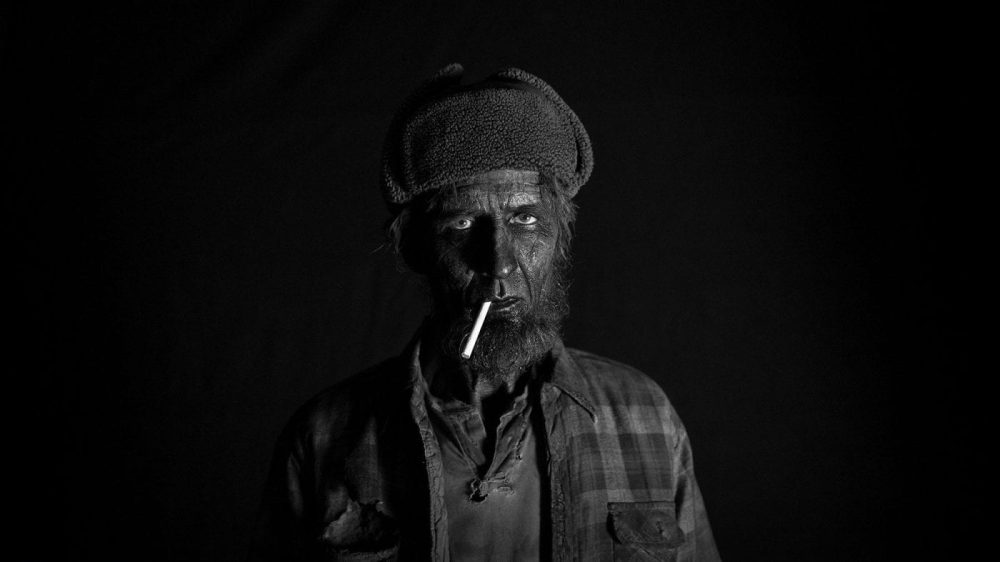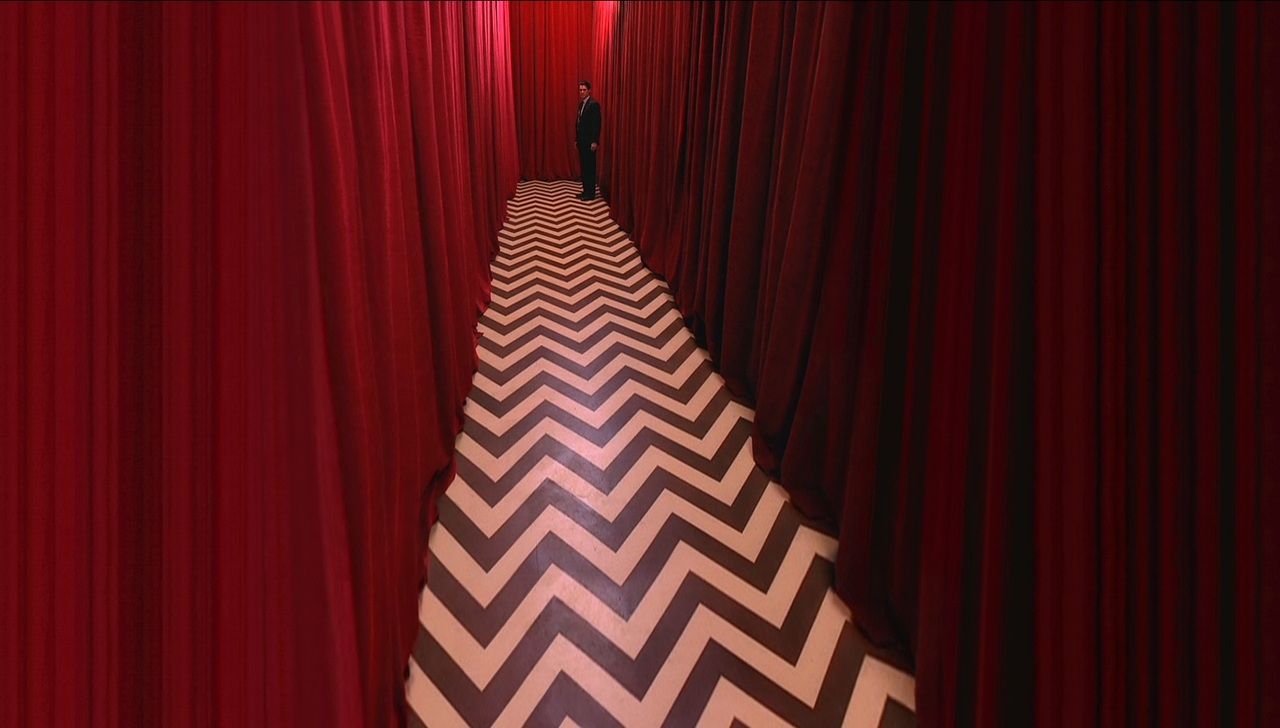
There are few places in television as instantly recognisable as the Black Lodge. Red velvet curtains. A black-and-white (or brown-and-cream if you prefer) chevron floor. Three armchairs. A suspiciously small table. A lamp. A Venus statue. A dancing man speaking backwards. You know; normal supernatural interior design.
Except there is a problem. We don’t actually know what the Black Lodge is.
We certainly know what we call the Black Lodge. Over more than three decades, the Red Room and the Black Lodge have become so intertwined in Twin Peaks fandom that the terms are often used interchangeably. Dale Cooper walks through the red curtains at Glastonbury Grove in the Season 2 finale, disappears for 25 years and eventually emerges in The Return. Case closed.
Only Twin Peaks refuses to make anything that easy.
The Man From Another Place explicitly calls the familiar Red Room “the waiting room.” Hawk describes the Black Lodge not as a red-curtained location but as the “shadow-self” of the White Lodge, a place every spirit must supposedly pass through on the way to perfection. Enter with imperfect courage and you encounter something called the Dweller on the Threshold, your own shadow self.
Then Fire Walk With Me introduces the Convenience Store, garmonbozia, a meeting of deeply peculiar entities and whatever exactly is happening with Phillip Jeffries. And then The Return arrives and essentially tips the entire box of supernatural Lego onto the floor. Now we have the Fireman’s fortress, the Mauve Zone, the Experiment, Woodsmen, electrical portals, tulpas, the Dutchman’s, a giant kettle-shaped Jeffries and a Red Room whose floor can apparently decide it has had enough of being a floor.
So perhaps we should start again. What does Twin Peaks actually tell us about the Black Lodge? And, more importantly, what happens if we take it seriously?
What Does Twin Peaks Actually Tell Us About the Black Lodge?

Our clearest explanation comes from Hawk in Season 2. He tells Cooper that his people believe in a place called the White Lodge, where the spirits governing man and nature reside. But there is also a legend of another place: the Black Lodge, the White Lodge’s shadow self. Every spirit must pass through it on the way to perfection. And there, according to Hawk, you encounter your own shadow self: the Dweller on the Threshold.
There is one particularly nasty condition attached. You need to face it with perfect courage. Anything less and, according to Hawk, the Lodge will annihilate your soul. Which seems like information Cooper might perhaps have written on the first page of his notebook in VERY LARGE LETTERS.
At this stage of the story, the Lodges sound almost straightforward. There is a White Lodge associated with goodness and a Black Lodge associated with darkness. Windom Earle becomes obsessed with finding the latter because he believes it will grant him extraordinary power. But Hawk’s description contains something much stranger than a simple Heaven-versus-Hell cosmology. He doesn’t say that everyone entering the Black Lodge meets a demon. He says they meet their shadow self. And that changes everything.
Is the Red Room Actually the Black Lodge?
This is where things immediately become slippery. When Cooper finally enters through the circle of sycamores at Glastonbury Grove, he finds the place we recognise instantly: red curtains, chevron flooring and interconnected rooms and corridors. But the Man From Another Place gives the room a very specific name. The waiting room.
And calling somewhere a waiting room strongly implies that there is somewhere else to go. Otherwise, it is simply a room with aggressively memorable curtains. This ambiguity has been debated by Twin Peaks fans for decades. The original series never provides us with a helpful supernatural floor plan saying YOU ARE HERE, BLACK LODGE GIFT SHOP THIS WAY.
Even the terminology is interesting. “Red Room” is largely our description of what we’re seeing. Hawk gives us the mythology of the Black Lodge. The Man From Another Place identifies the room Cooper is sitting in as the waiting room. Those aren’t necessarily three names for exactly the same thing.
The Return, however, complicates any attempt to separate them completely. Mr. C talks about avoiding being pulled back into what people call the Black Lodge. When the supernatural machinery designed to return him begins operating, red curtains appear to him. His manufactured replacement, Dougie Jones, is ultimately pulled into the familiar Red Room instead. So there is clearly an intimate connection. Perhaps the simplest way of thinking about it is this: The Red Room may be part of the Black Lodge without being the entirety of the Black Lodge. Or it may be a threshold connected to several supernatural realms. The clue could be sitting right underneath everyone’s feet.
Black.White. Neither one dominating the other. And Cooper is waiting between them.
A Place Between Worlds
Thresholds matter enormously in Twin Peaks. Doors, curtains, windows, roads, woods matter. Electricity definitely matters.
Characters repeatedly cross from one state of reality into another through very particular places. The Red Room behaves similarly. It doesn’t seem to obey ordinary geography. Cooper walks through one set of curtains only to enter another apparently identical room. People appear at different ages. The dead converse with the living. Doppelgängers materialise. Coffee changes consistency. Twenty-five years can pass outside while conversations inside seem to continue almost uninterrupted, even time itself isn’t behaving properly.
Remember Cooper’s first dream. Laura tells him she will see him again in 25 years. And she does. What Cooper experiences as prophecy in 1990 becomes, from another perspective, a perfectly ordinary statement made by someone for whom the meeting may already be happening. That raises an intriguing possibility. Perhaps the Lodge isn’t simply somewhere else. Perhaps it is somewhere outside our ordinary experience of space and time.
Glastonbury Grove: The Door in the Woods

Whatever the Black Lodge is, there is at least one place where the boundary between its world and ours becomes thin enough to cross. Glastonbury Grove.
The location feels ritualistic before anything supernatural even happens. Twelve sycamore trees stand in a circle around a pool of scorched engine oil. Under the correct astronomical conditions, red curtains appear among the trees and an apparently ordinary patch of Washington woodland becomes a doorway to somewhere that doesn’t obey the usual rules of space or time.
There is no spaceship. No glowing celestial staircase. No enormous Gothic gateway inscribed ABANDON HOPE ALL YE WHO ENTER HERE.
Just curtains in the woods. Which is somehow much worse. But the name Glastonbury deserves more attention than it usually gets.
The real Glastonbury in Somerset, England, is one of Britain’s great landscapes of accumulated myth. Over many centuries it has become associated with Christianity, Arthurian legend, Avalon, the Holy Grail, sacred springs, pilgrimage and, much later, a sprawling collection of esoteric and New Age traditions. Historically, Glastonbury Abbey was one of medieval England’s most important religious sites. But the stories surrounding it grew far beyond documented history.
Medieval tradition connected Glastonbury with Joseph of Arimathea, the biblical figure said to have provided the tomb in which Jesus was laid. Later legends claimed Joseph travelled to Britain and came to Glastonbury, sometimes bringing the Holy Grail with him. The famous Glastonbury Thorn was said to have grown when Joseph planted his staff in the ground and it miraculously took root.
Then there is Avalon. In the late twelfth century, monks at Glastonbury Abbey claimed to have discovered the graves of King Arthur and Guinevere, helping to cement the association between Glastonbury and the legendary Isle of Avalon. Whether the discovery was genuine, mistaken or an extremely successful medieval marketing campaign is another matter entirely. But the mythology stuck. Avalon is particularly interesting in a Twin Peaks context because it isn’t merely another geographical location in Arthurian tradition. It is an otherworldly place, famously associated with Arthur being taken away after his final battle. Depending on the version of the tradition, Avalon sits somewhere between enchanted island, paradise, healing realm and world beyond the ordinary world. A place reachable from here, but not quite here.
A Landscape Where Worlds Overlap
Over time, Glastonbury became the kind of place onto which different generations projected different ideas about the sacred. Christian pilgrimage sits alongside Arthurian mythology. Folklore overlaps with archaeology. Later occultists and spiritual seekers added ideas involving ley lines, earth energies, the zodiac, goddess spirituality and portals. Not all of those traditions are ancient, and we should be wary of throwing them into one enormous mystical cauldron and calling the result “Celtic wisdom.” Much of modern Glastonbury’s esoteric mythology is exactly that: modern. But that’s almost what makes the name so appropriate for Twin Peaks.
Glastonbury has become a place where history, religion, folklore, occultism and landscape are almost impossible to pull completely apart. So has Twin Peaks. And in both, certain locations seem to matter because people believe the landscape can hold more than ordinary geography.
Sacred Groves and Circles
Then there is the Grove. Groves have been treated as sacred spaces across numerous cultures. A group of trees can form a natural enclosure, separating a ritual or sacred space from the everyday world around it. Glastonbury Grove takes that basic idea and makes it unnervingly precise. There are twelve sycamores arranged in a circle. Circles are among the most persistent forms of sacred and magical boundary-making: completeness, cycles, protection, enclosure, the creation of a space separated from what lies outside it.
But this circle doesn’t keep something out. It seems to mark where something can come through. At its centre is not an altar, spring or sacred stone, but a pool of scorched engine oil. And that detail drags the ancient-looking ritual landscape abruptly into the modern technological world of Twin Peaks. Trees. Planets. A circle. Oil. Red curtains. It’s as if several different systems of symbolism have been layered on top of one another. Which, as we’ll discover again and again, is exactly how the supernatural operates in Twin Peaks.
Glastonbury, Avalon and the Lodges
There is another intriguing parallel worth considering. If Avalon is imagined as a realm beyond ordinary geography, accessible from our world but not entirely belonging to it, Glastonbury Grove may function similarly. Cooper doesn’t travel thousands of miles when he enters the circle. He crosses a boundary. The physical distance involved appears almost irrelevant. That may be why the entrance isn’t a conventional doorway at all. The curtains simply manifest when the necessary conditions are met. The Lodge was apparently always there. The door wasn’t.
Perhaps Glastonbury Grove isn’t the location of the Black Lodge. Perhaps it’s one of the places where our reality touches whatever the Lodge is.
And Why Sycamores?
Even the choice of tree invites questions. The sycamore has accumulated different symbolic meanings across cultures and periods, so we should resist the temptation to find one ancient definition and declare the case solved. But trees themselves are extraordinarily appropriate boundary symbols. Their roots disappear into the earth, their trunks inhabit our world, their branches reach towards the sky. Across mythology, world trees repeatedly connect different levels of existence: underworld, earthly world and heavens.
That doesn’t prove the twelve sycamores are intended as a literal world-tree reference. But visually and symbolically, Cooper’s entry into another realm through a circle of trees belongs to a very old human way of imagining passage between worlds. And Twin Peaks makes the forest itself feel aware of that possibility long before Cooper ever reaches the Grove. The woods aren’t scenery.
Something is in them. Hawk knows it. Briggs knows it. Margaret knows it. Even Bobby, who initially mocks the idea, eventually admits that there is something frightening about the woods. By the time the red curtains appear between the sycamores, perhaps we’re not seeing a supernatural invasion of an ordinary forest at all. We’re finally seeing what the forest has been hiding.
The Perfect Name for a Threshold
None of this means David Lynch and Mark Frost chose the name Glastonbury because they intended viewers to construct a precise equation: Glastonbury = Avalon = Black and White Lodges.
That would be far too neat.
But Glastonbury carries exactly the kind of cultural baggage Twin Peaks loves. A real place layered with history. A sacred site surrounded by legends. A landscape associated with another world. Christianity sitting on top of older stories, later occultism sitting on top of Christianity, folklore bleeding into supposed history until nobody can quite tell where one ends and another begins. And then, in Twin Peaks, someone gives that name to a circle of twelve trees where the boundary of reality occasionally opens.
Coincidence? Entirely possible. But this is The Twin Peaks Oracle. We’re at least going to have a look behind the curtain.
Jupiter and Saturn: When the Door Opens
Glastonbury Grove may be the place where Cooper can enter the Lodge, but knowing where the door is isn’t enough. He also needs to know when it opens.
The Owl Cave map supplies the answer. Cooper recognises two of its symbols as Jupiter and Saturn and realises that the pictograph is describing a specific astronomical event: the conjunction of the two planets. And Cooper doesn’t treat this as an arbitrary celestial password. He immediately connects the conjunction with something much bigger: periods of upheaval, changes in power and fortune, and the meeting of two opposing forces. Jupiter expands. Saturn contracts. Bring them together and, in Cooper’s interpretation, the result is concentration and intensification. Something potentially explosive.
Which is rather unfortunate when the explosion in question opens a door to the Black Lodge.
The Great Conjunction
There is real history behind this.
A conjunction occurs when two astronomical objects appear close together in the sky from our viewpoint on Earth. Jupiter and Saturn meet roughly once every twenty years, an event traditionally known as the Great Conjunction.
Astronomically, nothing supernatural happens. The planets aren’t actually colliding, touching or tearing a hole through reality. They simply appear close together from Earth because of their respective orbits. Astrologically, however, Jupiter and Saturn have carried enormous significance. For medieval and Renaissance astrologers, their conjunction wasn’t merely an interesting arrangement of planets. It could signal major changes in world affairs. And this tradition goes back much further than Victorian occultism or modern newspaper horoscopes.
Medieval European astrologers inherited sophisticated theories of Jupiter-Saturn conjunctions through Arabic astrological works translated into Latin. The ninth-century Persian astrologer Abu Ma’shar, known in medieval Europe as Albumasar, became particularly influential in developing the idea that cycles of Jupiter and Saturn could correspond with enormous historical transformations. Changes in kingdoms. Changes in religions. Changes in political power. Disasters. The rise and fall of entire eras.
Suddenly Cooper’s rather dramatic interpretation of the Owl Cave symbols doesn’t sound quite so random.
The Cosmic Clock
Part of what made Jupiter and Saturn so important was their apparent slowness. Before Uranus, Neptune and Pluto were known, Saturn was the furthest visible planet in the traditional cosmos. Jupiter and Saturn were therefore the two slowest-moving planets known to ancient and medieval astrologers. Their conjunctions could be imagined almost as the hands of an enormous celestial clock.
A Jupiter-Saturn conjunction occurs approximately every twenty years, but astrologers also tracked longer patterns created by successive conjunctions. Medieval thinkers believed these larger cycles could mark changes not merely in individual lives but in history itself.
That’s an extraordinarily Twin Peaks idea.
The heavens aren’t causing one person to have an awkward Tuesday. They’re telling you that the age is changing. And in Twin Peaks, the Owl Cave map seems to use the same principle. It isn’t merely a map of space; it’s a map of space and time. You need to stand in the right place when the cosmic clock reaches the right position. Only then does the door appear.
Jupiter Expands. Saturn Restricts.
The traditional symbolism of the planets makes their pairing even more interesting. Jupiter has long been associated astrologically with expansion, abundance, growth, authority and good fortune. Saturn is almost its mirror image: limitation, restriction, boundaries, time, age, mortality and necessity.
Jupiter says more. Saturn says enough. Jupiter expands the boundary. Saturn is the boundary. Put those principles together and you get a rather beautiful symbolic description of what happens at Glastonbury Grove.
A boundary opens. Something normally restricted becomes accessible. Two apparently contradictory forces occupy the same celestial position, and the separation between worlds temporarily gives way. We don’t need to assume Lynch and Frost constructed the Lodge mythology from an astrological textbook to appreciate how extraordinarily well that symbolism fits. In fact, the script itself points us towards it. Cooper explicitly describes Jupiter as expansive and Saturn as contractive before concluding that their conjunction represents intensification. The door doesn’t open simply because two planets happen to look close together.
Symbolically, expansion meets limitation at the exact moment a normally closed boundary becomes passable. That’s almost suspiciously perfect.
Saturn Has Another Connection to the Lodge: Time
Saturn brings another idea into the conversation.
Time.
In Western astrological tradition, Saturn has long been associated with time, age, limitation, and mortality, connections reinforced by the later identification of the Roman Saturn with the Greek Kronos and the cultural merging of Kronos with Chronos, the personification of time. And time behaves very strangely indeed once Cooper crosses those curtains.
Laura tells Cooper she will see him again in 25 years before either of them, from Cooper’s ordinary chronological perspective, could possibly know that.
People appear at different ages. The dead converse with the living. Events seem capable of being experienced before, during, and after they occur. By The Return, the question has become explicit:
“Is it future, or is it past?”
Perhaps Saturn’s presence at the opening is therefore appropriate on more than one level. Cooper isn’t merely crossing a boundary in space. He’s entering somewhere where the normal boundary imposed by time appears to weaken too.
And Jupiter?
If Saturn represents boundary and time, Jupiter traditionally represents expansion beyond existing limits. That creates an irresistible Lodge reading. Saturn defines the edge. Jupiter pushes beyond it. For one moment, the two principles meet, and the impossible becomes accessible. Again, this is interpretation rather than a canonical explanation. Twin Peaks never hands us an astrology textbook and tells us that Jupiter is literally overpowering Saturn’s dimensional boundary. But the symbolism is sitting there waiting for us. Rather like a little man in a red room.
Great Conjunctions and Great Change
There is another historical detail that makes the choice particularly delicious. Jupiter-Saturn conjunctions weren’t traditionally regarded simply as personally significant astrological events. Medieval and Renaissance astrologers used them in mundane astrology: astrology concerned with nations, rulers, religions, and large historical changes.
Some thinkers connected Great Conjunctions with the rise and fall of kingdoms and religions. They were even woven into apocalyptic predictions. In other words, these conjunctions could mark turning points in history. Now consider what happens during the conjunction in Twin Peaks.
Cooper enters the Lodge. His doppelgänger emerges. And for the next 25 years, the real Dale Cooper effectively disappears from the world. It is difficult to imagine a greater turning point in Cooper’s life. But perhaps the change is bigger than Cooper. By The Return, his journey has become entangled with BOB, Judy, Laura, the Fireman, and apparently the structure of reality itself. What initially looked like the astronomical combination required to unlock a door may actually be signalling a cosmic turning point.
The Dweller on the Threshold Wasn’t Invented by Twin Peaks

Hawk’s warning about the Black Lodge contains one of the biggest clues to what Cooper is actually walking into: “If you confront the Black Lodge with imperfect courage, it will utterly annihilate your soul.”
Why? Because, according to Hawk, somewhere within it waits the Dweller on the Threshold: the shadow self that a person must confront on the way towards spiritual perfection. It sounds exactly like the sort of wonderfully ominous phrase Twin Peaks might have invented. It didn’t. The Dweller on the Threshold already had more than a century of occult baggage by the time Dale Cooper walked between those red curtains. And once we follow that history, Cooper’s encounter with his doppelgänger becomes considerably more interesting.
It Begins With a Victorian Occult Novel
The phrase was popularised by Bulwer-Lytton in his 1842 novel Zanoni. Yes, Bulwer-Lytton. The same Victorian novelist responsible for the immortal opening: “It was a dark and stormy night.”
Apparently he wasn’t finished frightening future writers. Zanoni is an occult novel involving secret knowledge, spiritual initiation, Rosicrucian ideas, and the dangers involved in attempting to penetrate realities normally hidden from human perception. During one such attempt, the initiate Glyndon encounters something horrifying. The Dweller of the Threshold.
Bulwer-Lytton’s Dweller isn’t simply Glyndon’s evil twin. It is a terrifying supernatural presence associated with crossing into forbidden occult territory before the initiate is spiritually prepared. The original idea isn’t quite: You meet your Jungian Shadow. It’s closer to: There are doors human beings can open, and you had better be ready for what is standing on the other side. Already, we are uncomfortably close to Twin Peaks.
The Danger Isn’t Knowledge. It’s Premature Knowledge.
One of the most interesting ideas running through Zanoni is that occult knowledge requires preparation. You cannot simply learn the right words, perform the right ritual and demand access to higher realities. Spiritual development matters. Self-mastery matters. Readiness matters. Cross the threshold before you’re ready and the encounter can be catastrophic. And this is remarkably close to Hawk’s warning. Cooper knows where the Lodge is. He works out when it can be entered. He possesses the information required to open the door. But none of those things guarantee that he is spiritually prepared to cross it. That’s an important distinction because Cooper approaches supernatural mysteries much as he approaches investigations. Find the clues. Recognise the pattern. Solve the puzzle. Enter the Lodge.
But perhaps the Black Lodge isn’t a puzzle that can be solved. Perhaps knowledge can get you through the door while wisdom determines whether you survive what’s behind it. And those are very different things.
Then Theosophy Gets Hold of It
After Bulwer-Lytton, the Dweller on the Threshold escaped from fiction and entered modern esoteric thought. Theosophical writers adopted and developed the idea, gradually turning the Dweller into something increasingly psychological and karmic. Rather than simply being an external monster guarding forbidden spiritual territory, the Dweller could be understood as something created from the individual’s own unresolved lower nature. The unwanted parts of the self. Accumulated selfishness. Fear. Desire. Hatred. Attachment. Unresolved consequences of past actions. Everything the aspirant would rather leave downstairs while ascending towards enlightenment. Except apparently the universe doesn’t offer spiritual cloakrooms — you have to take your baggage with you, and eventually you have to open it.
The Monster at the Door Is Yours
This later esoteric version of the Dweller is where the connection with Twin Peaks becomes particularly striking. The Dweller isn’t necessarily something randomly waiting for travellers. It belongs to the traveller. It exists because they brought it with them. That transforms the meaning of the threshold. The obstacle between the initiate and spiritual advancement isn’t ultimately some external demon saying, “You shall not pass.” It’s everything within the initiate that hasn’t yet been confronted. Which makes Hawk’s choice of words extremely precise. He doesn’t simply tell Cooper that evil spirits inhabit the Black Lodge. He says:
“There you will meet your own shadow self.” Not a shadow. Your own. The Black Lodge apparently knows exactly what to show you.
The Threshold Matters Too
Even the word threshold deserves attention.
A threshold isn’t a destination. It’s the point between one state and another. Inside and outside. Known and unknown. Ordinary and sacred. Before and after.
The person standing on a threshold has left one condition but hasn’t yet entered the next. Which is almost a perfect description of the Red Room. The Man From Another Place calls it the Waiting Room. Cooper sits there before moving deeper into the maze of red curtains. People appear in unstable identities. The living and dead coexist. Past and future overlap. Nothing seems completely fixed. It is a place between states.
So when Hawk tells us that the Dweller waits on the threshold, perhaps we should take the geography as seriously as the psychology. The confrontation occurs precisely where transformation is supposed to happen. You cannot become whatever comes next without passing through what you already are.
Theosophy Has Another Idea That Fits Uncomfortably Well
Theosophical descriptions of the Dweller sometimes present it almost as an astral double, formed from the lower or unresolved aspects of the individual.
That word should immediately make every Twin Peaks fan sit up slightly straighter.
A double. A being that resembles you. Connected to the parts of yourself that have not been spiritually overcome. Standing between you and further spiritual development. And what does Dale Cooper encounter inside the Lodge? Dale Cooper. Same face. Same body. Completely different eyes. Then that double chases him through the red curtains, takes his place in the physical world and spends the next quarter-century living independently.
Then Jung Enters the Waiting Room
There’s another obvious connection. Carl Jung’s concept of the Shadow describes aspects of the personality that the conscious ego rejects, represses or refuses to recognise.
Importantly, the Shadow isn’t synonymous with evil. It can contain aggression, selfishness, sexuality, fear and socially unacceptable impulses, certainly. But it can also contain positive qualities the conscious personality has rejected. The crucial point is that these qualities remain part of us whether we acknowledge them or not. And the less consciously integrated they are, the more likely they are to appear indirectly: projected onto other people, erupting unexpectedly or taking symbolic form in dreams.
Perfect Courage Doesn’t Mean Being Unafraid
This also makes Hawk’s requirement for perfect courage much more interesting. Perfect courage probably doesn’t mean walking into the Lodge without experiencing fear. If that were the requirement, almost nobody could pass. Courage exists precisely because fear exists. The test may instead be whether the initiate can remain present when confronted with something unbearable. Can you look at the thing? Can you recognise it? Can you accept that it belongs to you? Can you resist the urge to turn away? And, most importantly: Can you stop running?
Cooper cannot.
What You Refuse to Face Gains Power
This gives Mr. C an especially disturbing symbolic meaning. If the Dweller represents everything Cooper cannot acknowledge or integrate, then Cooper’s failure doesn’t destroy those qualities. It liberates them. The rejected self becomes autonomous. And while Cooper remains trapped behind the curtains, his shadow walks out wearing his face. That’s almost painfully close to the psychological principle underlying Shadow work: what remains unconscious doesn’t simply disappear because we don’t want to look at it. It influences us precisely because we aren’t looking at it. Twin Peaks just makes the consequences considerably more dramatic. Ignore your Shadow in ordinary life and it may distort your behaviour. Ignore it in the Black Lodge and apparently it steals your clothes, leaves the building and embarks upon a 25-year crime spree.
Therapy suddenly seems extremely reasonably priced.
And This May Be Why the Black Lodge Exists
This brings us back to one easily overlooked part of Hawk’s explanation. Every spirit must apparently pass through the Black Lodge on the way to perfection. That means the Lodge may not exist simply as a realm of punishment. It has a function. You cannot reach the White Lodge by pretending darkness doesn’t exist. You cannot become spiritually whole by identifying only with the parts of yourself you consider good. At some point, you have to meet the rest.
The Black Lodge may therefore represent an unavoidable stage of transformation: the descent before ascent, confrontation before integration, darkness before illumination. Which would explain why the Dweller stands at the threshold. It isn’t necessarily there to prevent you from progressing. It’s there because confronting it is how you progress. And that makes Cooper’s failure much sadder. He finds the entrance, deciphers the map, arrives at precisely the right astronomical moment, crosses between worlds and reaches the threshold. But the final key was never hidden in Owl Cave. It wasn’t Jupiter. It wasn’t Saturn. It wasn’t scorched engine oil. It was Cooper. And that’s the one mystery Dale Cooper wasn’t ready to solve.
Why Is Cooper So Afraid of Himself?

It’s tempting to read Cooper’s reaction to his doppelgänger literally. A man with his face, white eyes and a murderous grin comes sprinting towards him through an interdimensional nightmare maze. Running seems, on balance, fairly reasonable.
But by this point, the Lodge has been frightening Cooper for some time, and Cooper doesn’t run from BOB. He runs from Cooper.
The Man Who Saves People
Dale Cooper is unusually comfortable confronting darkness when it belongs to somebody else. Murder, incest, abuse, possession and supernatural evil don’t send him running from Twin Peaks. If anything, Cooper moves towards mysteries other people instinctively avoid. But Cooper has a particular understanding of his own place within those stories. He’s the investigator. The protector. The man who arrives when something terrible has happened and tries to put things right.
And this didn’t begin with Laura Palmer. Before Laura there was Caroline Earle.
Cooper had been assigned to protect Caroline during a federal investigation. He fell in love with her. Caroline was Windom Earle’s wife, and Earle ultimately murdered her. Cooper therefore enters Twin Peaks already carrying a devastating combination of love, grief, guilt and failure.
Then he meets Annie Blackburn, and the pattern begins again. Another vulnerable woman. Another woman Cooper loves. Another woman Windom Earle targets specifically because Cooper loves her. Another woman Cooper must save.
So what does the Black Lodge show him?
Caroline.
Then Annie.
Then Caroline again.
The two women blur into one another until Cooper’s past and present are almost impossible to separate. The Lodge has found the wound.
Caroline, Annie, Laura… Cooper
Then there is Laura. Another woman Cooper couldn’t save.
Of course, Laura died before Cooper ever arrived in Twin Peaks. Rationally, her death cannot possibly be his failure. But Cooper’s relationship with Laura has never been entirely rational. He dreams about her; she whispers secrets to him. He becomes emotionally invested in understanding her, defending her and eventually, in The Return, changing what happened to her.
The Lodge surrounds Cooper with women he could not save and then it removes them. What’s left? Him.
The Lodge strips away the mystery, the investigation and the person who needs rescuing until the rescuer has nobody left to confront but himself. And Dale Cooper runs.
The Shadow of a Good Man
This doesn’t mean Mr. C is “the real Cooper.” Quite the opposite.
A Jungian Shadow isn’t a secret evil personality waiting underneath a nice one. It consists more broadly of qualities, impulses and truths that the conscious personality has rejected or cannot comfortably incorporate. And Cooper’s conscious identity is unusually bright. He’s compassionate, principled, optimistic, curious, courageous and almost relentlessly decent. But those qualities have shadows of their own. Confidence can become arrogance. Determination can become obsession. Protection can become control. Intuition can become certainty that you know better than everyone else. The desire to rescue can become an inability to accept that another person’s fate isn’t yours to rewrite. Even Cooper’s fearlessness has a shadow: the assumption that he can walk into forces he doesn’t understand and somehow remain untouched by them.
Perhaps the Lodge isn’t asking Cooper to admit that he’s secretly evil. It’s asking something far more difficult. Are you willing to accept that being a good man doesn’t mean everything inside you is good? And perhaps Cooper isn’t.
Mr. C Is Cooper With Something Missing
Look closely at Mr. C and the relationship becomes even more disturbing. He retains many recognisably Cooper qualities.
He’s extraordinarily intelligent. Focused. Resourceful. Calm under pressure. Charismatic when he chooses to be. Almost impossible to intimidate. Once he decides he wants something, very little can stop him. Those characteristics didn’t suddenly appear in the Lodge; they’re Dale Cooper’s strengths. But Mr. C has them without Cooper’s empathy, tenderness, humour, morality or wonder. It’s not simply that Mr. C is everything Cooper isn’t. He is some of what Cooper is, violently separated from everything that keeps those qualities human. The result is monstrous.
Perhaps that’s precisely what failure to integrate the Shadow means in the metaphysical language of Twin Peaks. What you refuse to recognise doesn’t disappear. It becomes autonomous — in Cooper’s case, horrifyingly literally.
Cooper’s Real Shadow May Be Control
And The Return suggests Cooper still hasn’t completely learned the lesson. After 25 years, he finally returns. BOB is defeated. The nightmare that began with Laura Palmer’s murder appears, impossibly, to be over.
Cooper could stop, but instead, he decides to save Laura Palmer. Not symbolically. He goes back to 1989, finds Laura in the woods and leads her away from the place where she will be murdered. Once again, Dale Cooper is the rescuer. Once again, there’s a woman who needs saving. Once again, Cooper believes he can make things right. And once again, he may be entering forces whose consequences he doesn’t understand. This makes his final journey with Carrie Page feel less like an unrelated mystery and more like the continuation of the same spiritual problem that began in the Black Lodge.
Cooper cannot accept helplessness. Caroline died. Laura died. Some things cannot be undone by solving the right puzzle.
For a man whose entire identity is built around helping, protecting and understanding, accepting that may be more terrifying than any monster BOB could show him. Perhaps that’s why the Dweller takes Cooper’s own face. The Lodge doesn’t need to discover what Dale Cooper fears. It already knows.
A Dale Cooper who isn’t the hero of the story.
Laura Palmer Does Something Cooper Cannot

Which brings us to Laura. Because if Cooper’s encounter with the Lodge is an initiation, Fire Walk With Me gives us another. And Laura’s ends very differently.
Laura has been living with darkness for years. BOB has terrorised her since childhood. By the end of Fire Walk With Me, she understands the horrifying human reality behind him. She knows BOB wants to enter her. Possess her. Become her. And she refuses.
Laura is frightened. Traumatised. Addicted. Desperate. She has spent much of the film moving towards death and knows on some level that something terrible is coming. But at the decisive moment, she chooses. She puts on the ring. Whatever else the ring means, BOB does not get what he wants. Laura dies as Laura and that creates an extraordinary inversion at the heart of Twin Peaks.
The brilliant FBI agent who seems spiritually prepared for everything enters the darkness voluntarily and cannot face himself. The frightened seventeen-year-old girl everyone thinks needs rescuing has already been fighting that darkness for years. And when the final choice arrives? Laura holds the line. Perhaps that is why the ending of Fire Walk With Me, despite everything we’ve just witnessed, is so strangely beautiful.
Laura sits in the Red Room. Cooper stands beside her. An angel appears. Laura cries, and then she smiles. If this is simply Hell, it is behaving very strangely indeed.
So Who Actually Lives in the Black Lodge?
This is another assumption worth questioning. BOB is routinely described as a Black Lodge entity. So is MIKE, The Man From Another Place, The Tremonds, The Jumping Man. Later, the Woodsmen.
But does Twin Peaks actually tell us that all of these beings come from one place and belong to one side? Not really. Their relationships appear considerably more complicated. MIKE and BOB were once partners. MIKE claims to have seen the face of God and changed. The Arm is connected to MIKE but possesses its own identity. By The Return, the Arm has evolved and apparently has a doppelgänger of its own. The Tremonds move through different identities and locations. The Woodsmen operate around the Convenience Store.
The Fireman appears to oppose whatever forces are associated with BOB and the Experiment. Phillip Jeffries appears to have become… well. Something. At some point even the phrase “spirit world” begins to feel hopelessly inadequate.
There Are Rules Here
One of the strangest scenes in Fire Walk With Me provides another clue.
After Laura’s murder, MIKE and the Arm confront BOB. They demand garmonbozia — Pain and sorrow — and BOB gives it to them. Think about how odd that is. BOB is one of the most terrifying beings in Twin Peaks, yet apparently he cannot simply tell everyone to get lost and keep his creamed corn. There are obligations, transactions, rules.
The Season 2 finale gives us another example. Windom Earle tells Cooper that he will release Annie if Cooper gives him his soul. Cooper agrees. Then BOB appears. Earle cannot simply take Cooper’s soul. Whatever else BOB is doing, he effectively overrules the transaction. Earle has tried to exercise authority he doesn’t possess. And so BOB destroys him.
That suggests something much stranger than a dimension populated by generic evil spirits. It suggests an ecosystem. Perhaps even a hierarchy. There are resources. There are exchanges. There are boundaries. There are consequences for breaking rules. We simply don’t understand the rules.
Then The Return Makes Everything Worse
For 25 years, we could at least pretend we had a rough map. White Lodge. Black Lodge. Waiting Room. Woods.
Then Twin Peaks: The Return arrived, looked at our carefully drawn diagram and set fire to it. Cooper leaves the Red Room and falls through what appears to be an enormous void. He reaches the Mauve Zone. There is an endless purple sea. Naido occupies a strange structure surrounded by space. The Fireman lives in an enormous fortress containing machinery capable of observing events on Earth and, apparently, responding to them.
There is the Convenience Store. The Dutchman’s. The Experiment. Electrical sockets that function as routes between realities. People can be manufactured as tulpas. Major Briggs appears to have transcended ordinary bodily existence. And Phillip Jeffries, formerly a relatively standard David Bowie-shaped FBI agent, now apparently exists in, or as, a vast, steaming machine.
Nobody explains any of this. Quite inconsiderate, really. But something important has happened. The supernatural geography of *Twin Peaks* has become much bigger than two Lodges.
Maybe Hawk Gave Us the “Official” Version
That doesn’t necessarily mean Hawk was wrong. Perhaps “White Lodge” and “Black Lodge” are human names for forces or realms that cannot be adequately described in human language.
This idea becomes especially interesting when we bring The Secret History of Twin Peaks into the picture. Mark Frost dramatically expands the mythology beyond Laura Palmer’s murder. UFO encounters, Project Blue Book, Douglas Milford, Major Briggs, occult history, secret societies and figures such as Jack Parsons become part of a much longer human encounter with something we don’t understand. People interpret that something according to the language available to them.
One generation sees spirits; another sees angels and demons. Some see extraterrestrials, while others see interdimensional beings. The Air Force sees a classified problem requiring surveillance. Dale Cooper sees red curtains.
What if they’re all looking at different parts of the same thing? That question will take us much further into the woods in future Oracle investigations.
So, What Is the Black Lodge?
After all that, we’re left with the deeply satisfying answer: We don’t know.
But we know considerably more about what the question means. The Black Lodge doesn’t behave like Hell. It doesn’t seem to be merely a physical place populated by evil spirits. Nor does reducing it to a psychological metaphor account for what actually happens in the story. It seems to exist at an intersection between physical reality and consciousness. Between matter and spirit. Between past and future. Between the self we present to the world and the self waiting behind the curtain. And for all the monsters, Woodsmen, doppelgängers and interdimensional horrors lurking throughout Twin Peaks, that may still be the most frightening possibility of all.